Fun
How Old Are You on Mars? Planet Age Facts
By Ecosys World Editorial Team · Published on 2026-02-20
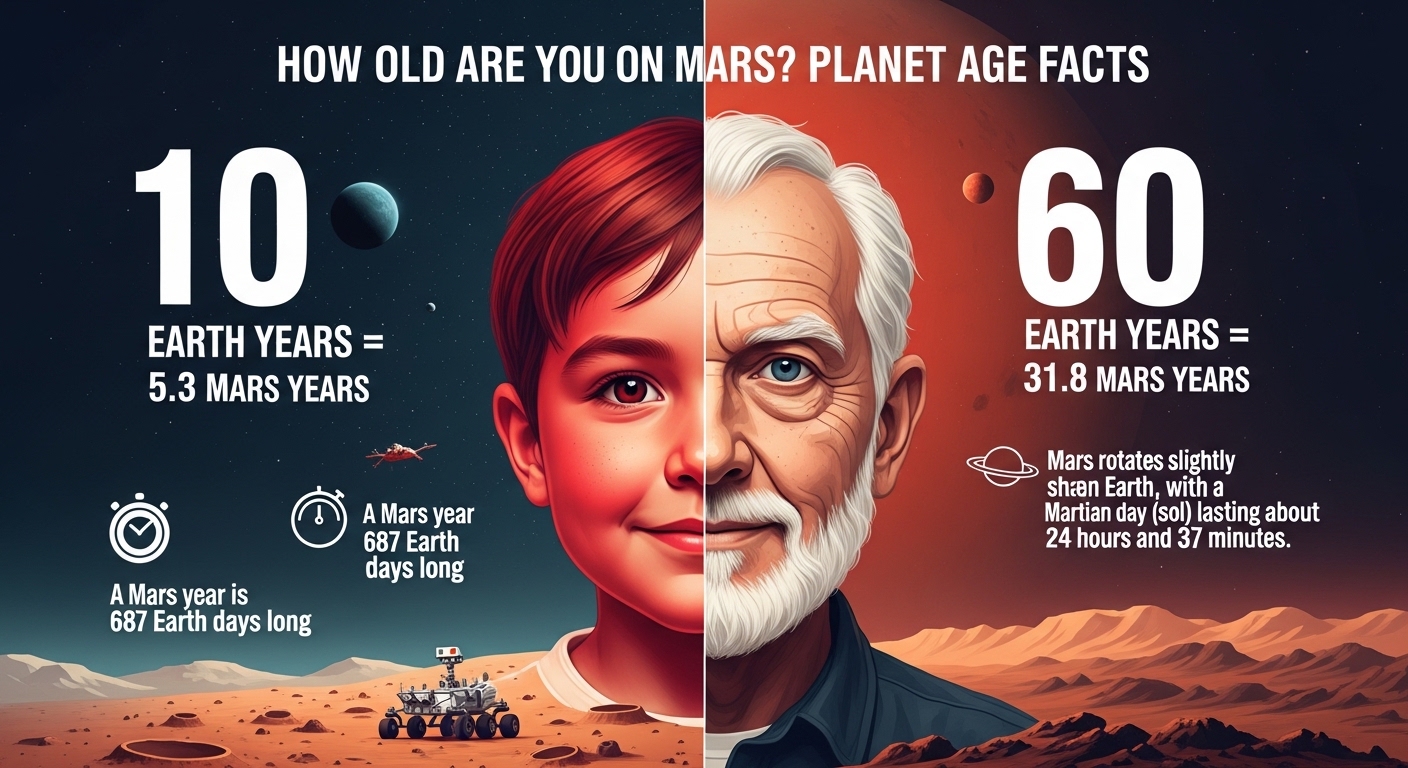
Fun facts about how your age changes on different planets in our solar system.
Why Your Age Depends on the Planet
A 'year' is simply the time it takes a planet to complete one orbit around the Sun. Earth's year is approximately 365.25 days, which is why we have leap years. But other planets orbit at vastly different speeds depending on their distance from the Sun. Mercury, the closest planet, whips around in just 88 Earth days. Neptune, the farthest, takes nearly 165 Earth years to complete a single orbit. This means your age — measured in planetary years — changes dramatically depending on which world you're standing on.
How Old Are You on Mars?
Mars takes about 687 Earth days to orbit the Sun, meaning a Martian year is roughly 1.88 Earth years. To find your age on Mars, divide your age in Earth days by 687. A 30-year-old on Earth is only about 15 in Martian years. This isn't just a fun fact — it has real implications for future Mars colonists who will need to develop a new calendar system and decide how to mark birthdays and important dates on the Red Planet.
Jupiter and Saturn: Ancient by Earth Standards
Jupiter takes nearly 12 Earth years to orbit the Sun, so a 12-year-old Earthling is just 1 Jovian year old. Saturn moves even more slowly, completing its orbit in about 29.5 Earth years. This means most adults have never even completed a single Saturnian year in their lifetime — a sobering thought that gives a sense of the vast timescales involved in our solar system.
Mercury: Racing Through Years
At the other end of the spectrum, Mercury orbits the Sun in just 87.97 Earth days. This means Mercury experiences about 4.15 years for every Earth year. A 20-year-old would already be over 83 in Mercurian years. However, Mercury's extreme proximity to the Sun means it's tidally locked — one side always faces the Sun, experiencing temperatures over 400°C, while the other sits at -180°C. Age on Mercury would be the least of your concerns.
The Fun of Planetary Age
Calculating your age on other planets is a delightful way to appreciate the scale of our solar system. It also sneaks in some genuine science — orbital mechanics, the definition of a year, and why the planets move at different speeds (Kepler's third law: the further a planet is from the Sun, the longer its orbital period). Try our Planet Age calculator to see your age across every planet in the solar system.