Population
Urbanization Trends: Cities of the Future
By Ecosys World Editorial Team · Published on 2026-08-15
How rapid urbanization is reshaping cities and demographics worldwide.
The Scale of Urban Growth
The world is urbanising at an unprecedented pace. In 1950, just 30% of the global population lived in cities. By 2023, over 57% did. By 2050, the UN projects that 68% of humanity — approximately 6.7 billion people — will be urban residents. This shift represents one of the most profound demographic transformations in human history, reshaping economies, environments, and cultures on every continent.
Megacities and Their Challenges
Cities with populations exceeding 10 million are classified as megacities. There are currently 35 megacities globally, home to approximately 12% of the world's urban population. Tokyo remains the largest at over 37 million. But the fastest-growing megacities are in the Global South — Kinshasa, Lagos, Dhaka, and Karachi are expanding at rates that strain infrastructure, housing, water supply, and transport systems far faster than governments can respond. Informal settlements house roughly 1 billion people worldwide — about a quarter of the urban population.
Urbanisation's Economic Benefits
Cities are engines of productivity. The concentration of people, ideas, and capital creates agglomeration effects — proximity spurs collaboration, reduces transaction costs, and enables specialisation. Studies consistently find that doubling a city's population increases average productivity by 15%. Urban workers earn higher wages, have access to better healthcare and education, and are more likely to escape poverty than their rural counterparts. This is why rural-to-urban migration, despite its challenges, is often a rational individual economic decision.
Environmental Pressures
Urban expansion consumes agricultural land, fragments wildlife habitats, and creates urban heat islands where hard surfaces absorb and radiate heat. Cities account for approximately 70% of global CO2 emissions, driven by energy use in buildings, transport, and industry. However, dense urban living is actually more energy-efficient per person than suburban or rural living — compact cities with good public transport, district heating, and walkable neighbourhoods have significantly lower per-capita emissions than sprawling car-dependent development.
The Future City
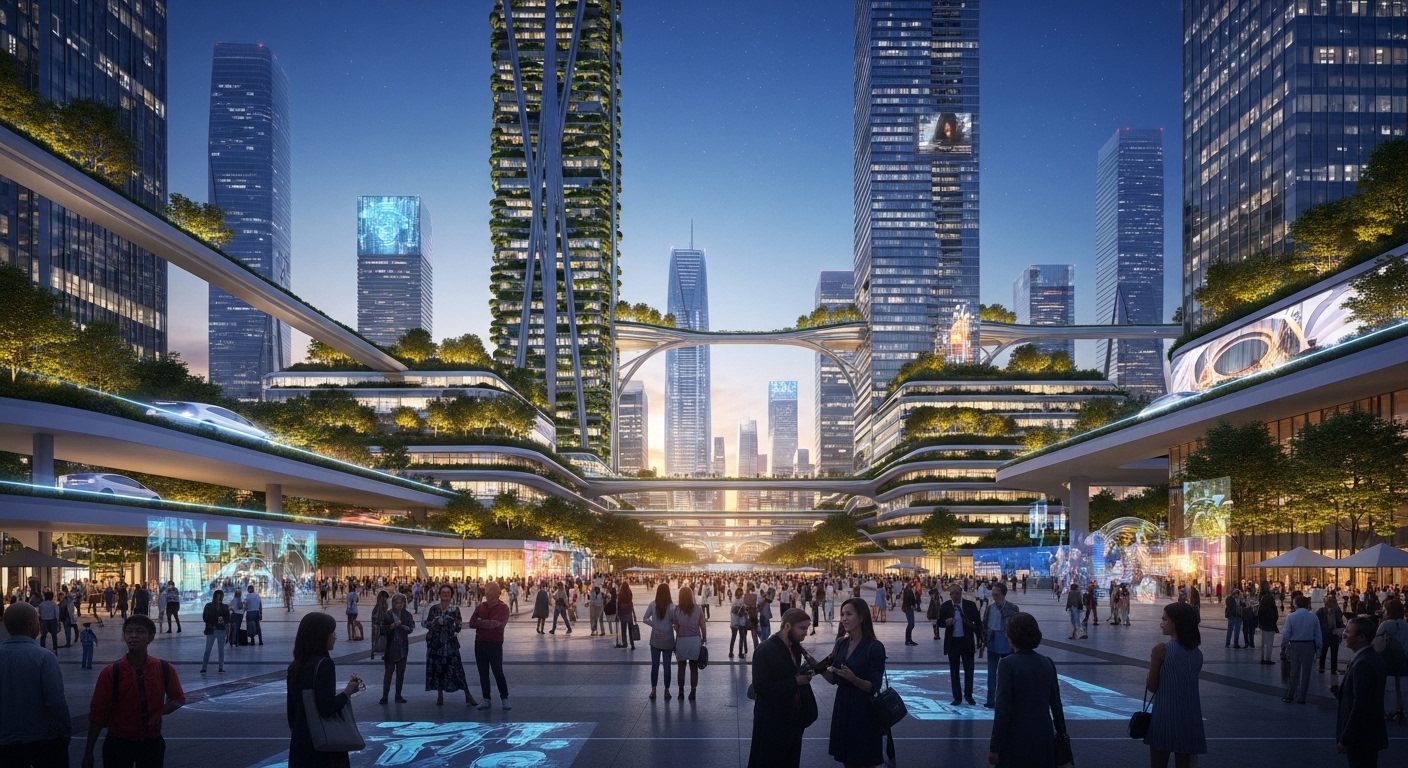
Urban planners and policymakers are experimenting with various models for more sustainable and equitable cities. The '15-minute city' concept — where all essential services are accessible within a 15-minute walk or cycle — has been adopted in Paris and explored in dozens of other cities. Investment in green infrastructure, public transport electrification, and mixed-use zoning are consistently shown to reduce emissions and improve quality of life. The cities that solve these challenges will be models for the billions who will urbanise in coming decades.