Education
GPA Calculation Methods Around the World
By Ecosys World Editorial Team · Published on 2026-06-20
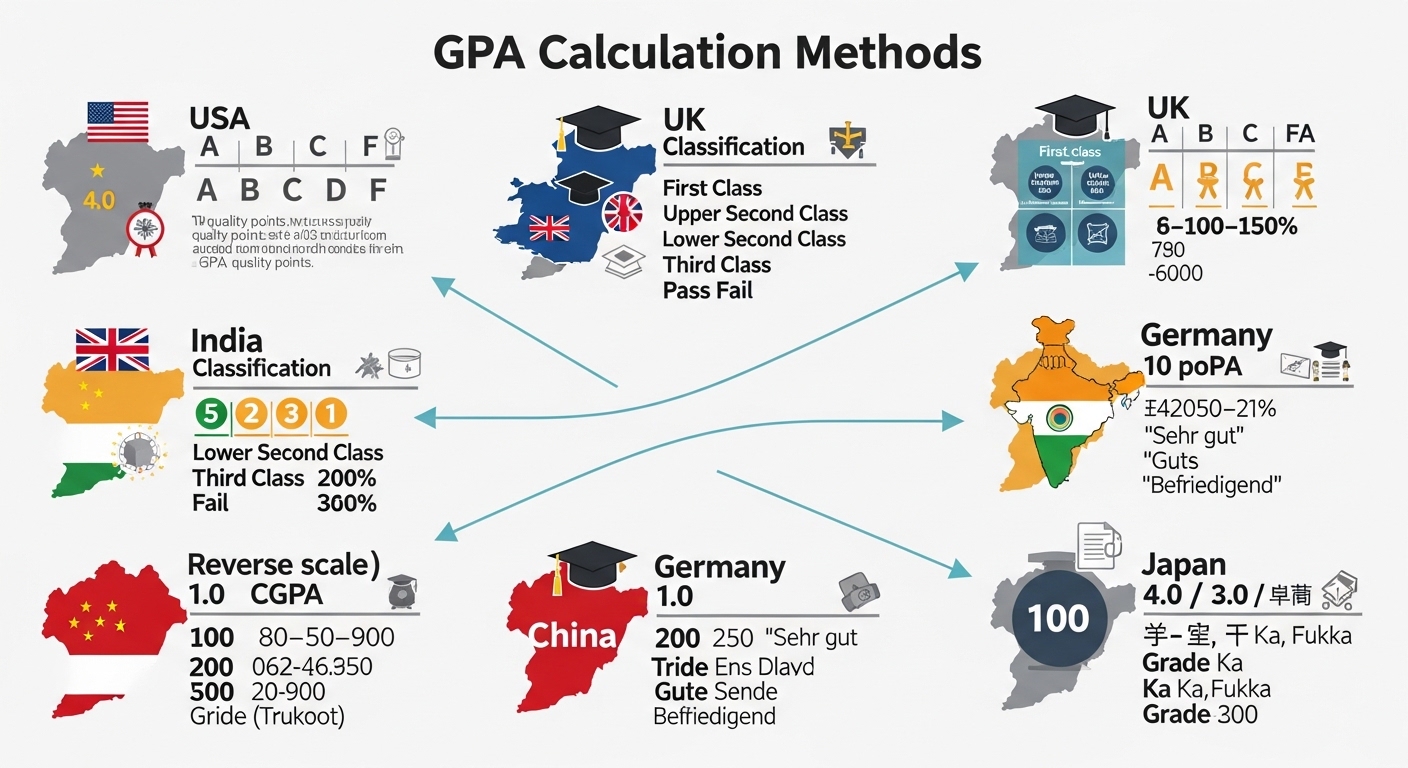
Different countries use different grading systems — here's how they compare.
The US 4.0 GPA Scale
The 4.0 GPA scale is standard at most American high schools and universities. Letter grades are converted to grade points: A = 4.0, B = 3.0, C = 2.0, D = 1.0, F = 0. Your GPA is the weighted average of these values, weighted by the number of credit hours each course carries. A 3.5 GPA signals a B+/A- average and is generally considered strong for graduate school applications. A 3.0 is the minimum GPA many employers specify for entry-level positions.
Weighted vs. Unweighted GPA
Unweighted GPA treats all courses equally on the 4.0 scale. Weighted GPA gives extra credit points for advanced courses — AP (Advanced Placement) and IB (International Baccalaureate) classes typically add 0.5 or 1.0 to the grade value, allowing weighted GPAs above 4.0. Colleges in the US generally recalculate applicants' GPAs on an unweighted scale to create fair comparisons, so a weighted 4.5 GPA from a rigorous course load and an unweighted 4.0 are evaluated with this context in mind.
International Grading Systems
Grading systems vary dramatically across countries. The UK uses a degree classification system (First Class: 70%+, Upper Second: 60–69%, Lower Second: 50–59%). Germany uses a 1–5 scale where 1 is the best (ausgezeichnet: excellent) and 5 is a fail — the opposite intuition to Americans. France grades out of 20, with 16+ considered exceptional. Australia typically uses High Distinction, Distinction, Credit, Pass, and Fail. Converting between these systems for international applications requires careful use of official equivalency tables.
Cumulative vs. Semester GPA
Your cumulative GPA encompasses all courses taken throughout your academic career. Your semester or term GPA covers only the most recent term. A strong recent semester GPA alongside a lower cumulative GPA shows an upward trend that admissions officers and employers often look upon favourably — it signals that early struggles have been overcome. When applying to graduate programmes, some institutions weight recent grades more heavily than older ones.
Improving Your GPA
Grade replacement policies at some universities allow you to retake a course and have the new grade replace the old one in GPA calculations. Taking additional high-credit courses and performing well is the most mathematically effective way to raise a cumulative GPA over time. Knowing your GPA precisely — which our GPA calculator makes straightforward — helps you set realistic grade targets for each remaining course to reach a specific final GPA goal.