Finance
Understanding Exchange Rates: A Simple Guide
By Ecosys World Editorial Team · Published on 2026-06-05
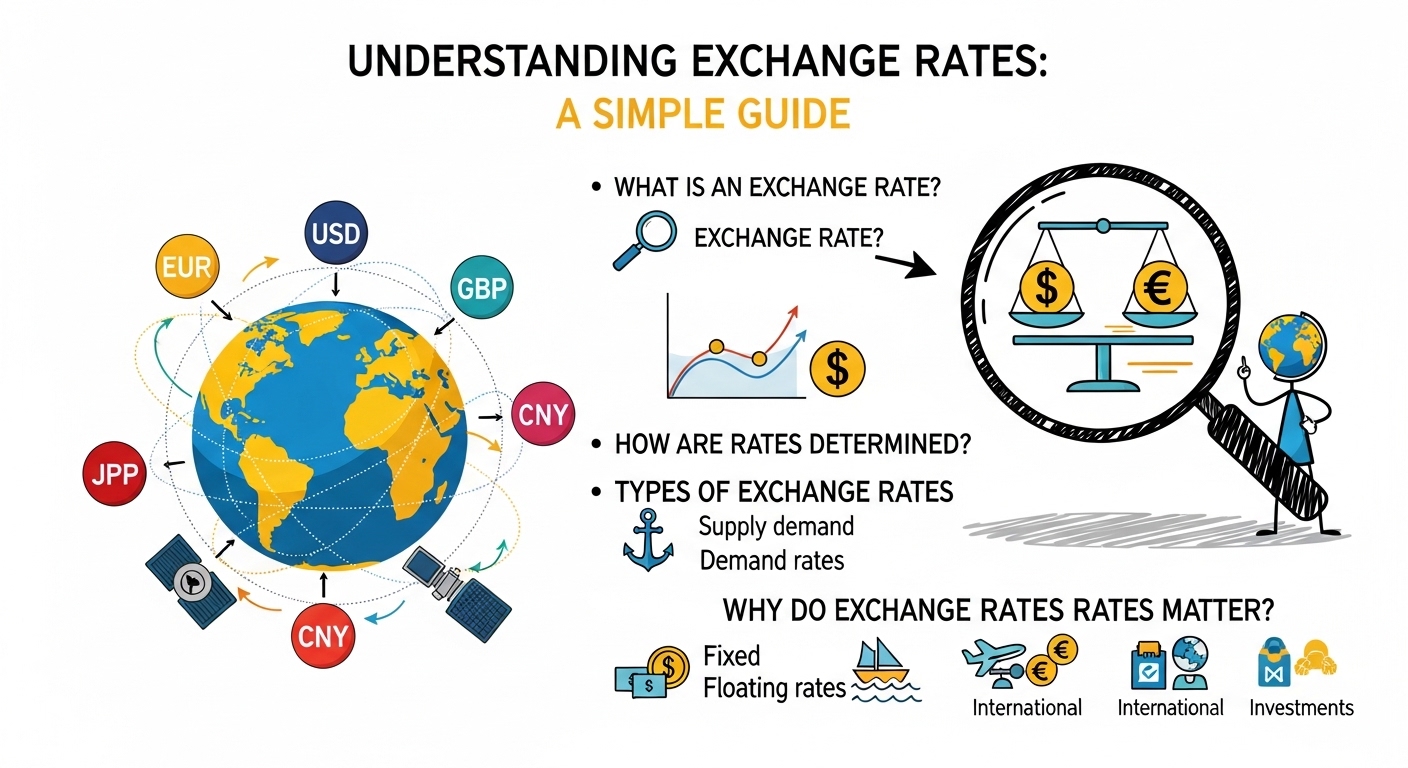
Learn how exchange rates work and what factors influence currency values.
What Determines an Exchange Rate
Exchange rates reflect the relative economic strength and stability of two countries. At their most fundamental level, they are driven by supply and demand for each currency in the global foreign exchange market. When investors believe an economy is growing strongly, they buy its currency to invest there, pushing its value up. When confidence falls — due to political instability, inflation, or weak economic data — the currency depreciates as investors sell it.
Interest Rates: The Primary Driver
Central bank interest rate decisions are the single most powerful driver of currency movements in developed economies. Higher interest rates attract foreign capital seeking better returns, increasing demand for the currency and pushing its value up. This is why Federal Reserve and European Central Bank announcements cause immediate, significant currency movements. The 'carry trade' — borrowing in low-interest currencies to invest in high-interest ones — moves billions of dollars daily and is a major force in forex markets.
Inflation and Purchasing Power Parity
High inflation erodes a currency's purchasing power relative to countries with lower inflation. Purchasing Power Parity (PPP) theory suggests that exchange rates should eventually adjust so that identical goods cost the same in different countries when prices are converted to a common currency. In practice, PPP provides a long-run anchor for exchange rate movements but can diverge significantly in the short term due to capital flows, speculation, and trade barriers.
Trade Balances and Current Accounts
A country that exports more than it imports has foreign buyers consistently purchasing its currency to pay for goods and services. This sustained demand supports the currency's value. Conversely, a persistent trade deficit means the country's currency is constantly being sold to buy foreign goods, creating downward pressure. The US dollar's status as the world's reserve currency is a special case that allows the US to run persistent deficits without the usual currency consequences.
Practical Implications for Everyday Use
For travellers, exchange rate movements can make a significant difference to holiday costs. A 10% depreciation in your home currency means your holiday abroad effectively costs 10% more. For businesses, exchange rate volatility can wipe out profit margins on international contracts. Our currency converter gives you real-time mid-market rates so you always know what a fair rate looks like, whether you're comparing bank quotes or shopping internationally.