Holidays
European Public Holidays: A Complete Overview
By Ecosys World Editorial Team · Published on 2026-07-01
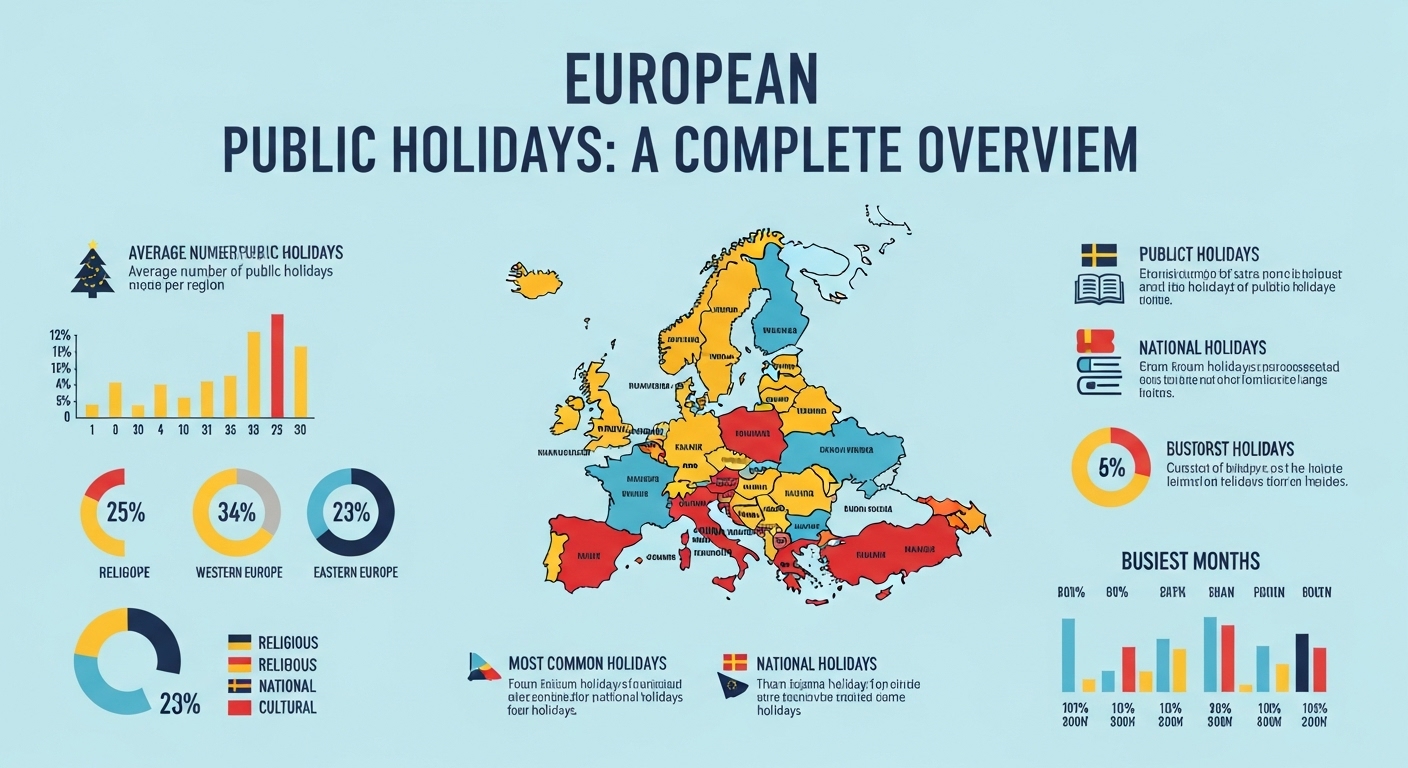
A country-by-country guide to public holidays across Europe.
Holidays Common Across Europe
Several holidays are observed almost universally across European countries. New Year's Day (January 1) and Christmas Day (December 25) appear on virtually every European public holiday calendar, as do Good Friday and Easter Monday in Christian-majority countries. Labour Day on May 1 is a public holiday across most of Europe, including France, Germany, Italy, Spain, and Eastern European countries — though not in the United Kingdom, where the bank holiday falls on the first Monday of May.
United Kingdom
England and Wales observe 8 bank holidays per year; Scotland has 9 (including St Andrew's Day) and Northern Ireland 10 (including St Patrick's Day and the Battle of the Boyne). The Late Summer Bank Holiday in late August is unique to the UK and Ireland. Unlike many European countries, UK bank holidays that fall on a weekend are replaced by the following Monday — known as a 'substitute' bank holiday.
Germany and France
Germany's public holidays vary by state due to its federal structure — Catholic Bavaria has more religious holidays than Protestant northern states. Germany observes German Unity Day on October 3. France observes 11 national public holidays including Bastille Day on July 14, commemorating the French Revolution. The Assumption of Mary (August 15) is a public holiday in France and many Catholic European countries, reflecting the continent's religious heritage.
Southern Europe
Italy observes 12 national public holidays and individual regions add local saint's days. Spain's 14 national holidays include National Day on October 12 and Constitution Day on December 6. Portugal observes Freedom Day on April 25, commemorating the 1974 Carnation Revolution that ended decades of authoritarian rule — one of Europe's most politically significant public holidays. Greece's Ohi Day on October 28 marks its refusal to submit to Italian ultimatum in 1940.
Nordic Countries
Scandinavian countries have distinctive holiday calendars that reflect Lutheran traditions and Nordic culture. Midsummer (late June) is one of the most important celebrations in Sweden and Finland, involving all-night celebrations around bonfires marking the summer solstice. Norway's Constitution Day on May 17 is celebrated with extraordinary national pride — children's parades, traditional costume (bunad), and brass bands fill every town across the country.