Holidays
Public Holidays in the Middle East
By Ecosys World Editorial Team · Published on 2026-08-05
Understanding Islamic holidays and national celebrations in the Gulf region.
The Islamic Calendar
Most public holidays in Muslim-majority Middle Eastern countries follow the Islamic Hijri calendar, a lunar calendar of 12 months totalling 354 days — about 11 days shorter than the Gregorian year. This means Islamic holidays shift approximately 11 days earlier each Gregorian year, cycling through all seasons over a 33-year period. This is why Ramadan and Eid dates change annually on Western calendars, and why planning around these holidays requires checking the calendar each year rather than assuming fixed dates.
Ramadan: The Month of Fasting
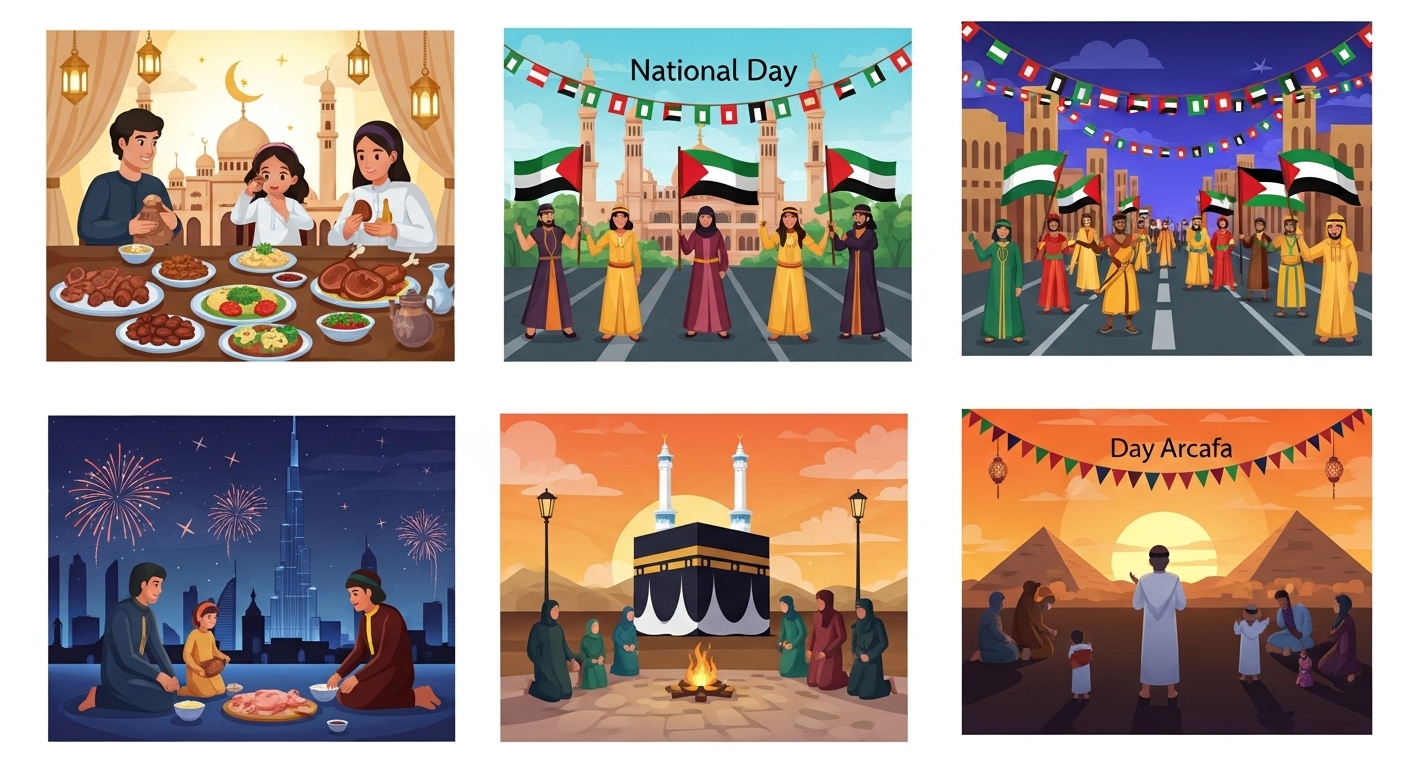
Ramadan is not a public holiday but a month of daily fasting from dawn to sunset, during which the rhythm of life across the Muslim world changes dramatically. Businesses, government offices, and restaurants operate on reduced hours. The pre-dawn meal (suhoor) and the fast-breaking meal at sunset (iftar) become the day's social anchors. For travellers, restaurants and cafes may be closed during daylight hours. The final days of Ramadan are intensely anticipated — the sighting of the new crescent moon announces Eid al-Fitr.
Eid al-Fitr and Eid al-Adha
Eid al-Fitr (the Festival of Breaking the Fast) marks the end of Ramadan with prayers, feasting, charity (Zakat al-Fitr), and gift-giving. Across Gulf states, it's typically a 3-4 day public holiday. Eid al-Adha (the Festival of Sacrifice), roughly 70 days later, commemorates Ibrahim's willingness to sacrifice his son and coincides with the annual Hajj pilgrimage to Mecca. It involves the slaughter and distribution of livestock, with meat shared between family, neighbours, and those in need. Both Eids are among the most important Islamic occasions.
National Days
Each Gulf state observes its own National Day with considerable ceremony. Saudi National Day on September 23 marks the unification of the kingdom in 1932 and has evolved into an increasingly spectacular public celebration with fireworks, concerts, and cultural exhibitions. UAE National Day on December 2 commemorates the federation of the seven emirates in 1971 and is celebrated with fireworks over the Burj Khalifa. Qatar National Day on December 18 marks the country's emergence as an independent state.
Practical Advice for Visitors
During Ramadan, visitors to Muslim-majority countries should avoid eating, drinking, or smoking in public during daylight hours as a mark of respect — this is also legally enforced in some countries like Saudi Arabia. Dress conservatively, particularly around mosques and during religious occasions. Many businesses and government services operate on reduced hours throughout Ramadan, and some close entirely for Eid. Booking travel to the Gulf during these periods requires awareness that the working week runs Sunday–Thursday in many countries.