Finance
Loan Calculator Explained: Make Smarter Decisions
By Ecosys World Editorial Team · Published on 2026-04-05
Understand how loan calculators work and use them to plan your finances.
The Anatomy of a Loan
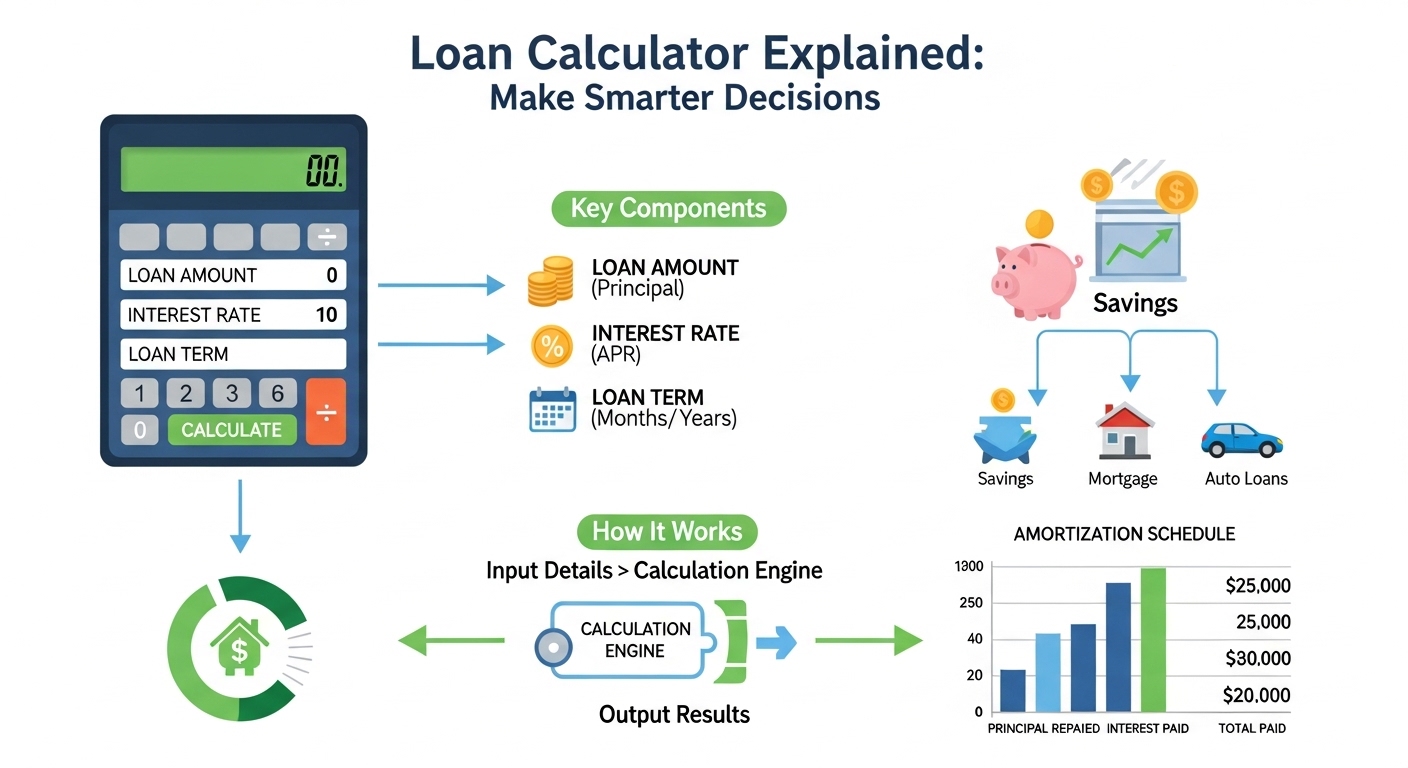
Every loan has four key components: the principal (amount borrowed), the interest rate (cost of borrowing), the loan term (repayment period), and the repayment frequency (monthly, fortnightly, etc.). Understanding how these interact is essential before signing any loan agreement. A small change in interest rate or term can mean thousands of dollars more or less paid over the life of a loan.
How Monthly Payments Are Calculated
Loan repayments are calculated using an amortisation formula that ensures the loan is fully paid off by the end of the term through equal instalments. Each payment covers two things: interest accrued on the outstanding balance, and a reduction in the principal. In the early months, most of your payment goes toward interest. As the principal reduces, more of each payment goes toward the actual debt — this is why making extra repayments early in a loan has a disproportionately large impact on total interest paid.
APR vs. Interest Rate
The Annual Percentage Rate (APR) is a more honest measure of a loan's total cost than the headline interest rate. APR includes additional fees — origination fees, processing fees, and other charges — expressed as an annual percentage. Two loans with the same headline rate but different fee structures will have different APRs. Always compare APRs, not interest rates, when evaluating loan offers.
The Impact of Loan Term
A longer loan term means lower monthly payments but significantly higher total interest paid. A $20,000 loan at 8% over 3 years costs roughly $3,200 in interest. The same loan over 7 years costs about $6,100 in interest — nearly twice as much — despite the same rate. Our loan calculator shows both monthly payment and total interest paid, helping you see the true trade-off between affordability now and total cost over time.
Smart Strategies for Borrowers
If your budget allows, round up your monthly payment — paying an extra $50 or $100 per month can shave months off a loan term and save significant interest. Make sure your loan has no prepayment penalty before doing this. For mortgages, consider bi-weekly payments instead of monthly — this results in one extra payment per year, reducing a 30-year mortgage to roughly 26 years without feeling the strain of a higher formal payment.