Tools
URL V2 Encoding Explained: Why Special Characters Matter
By Ecosys World Editorial Team · Published on 2026-10-05
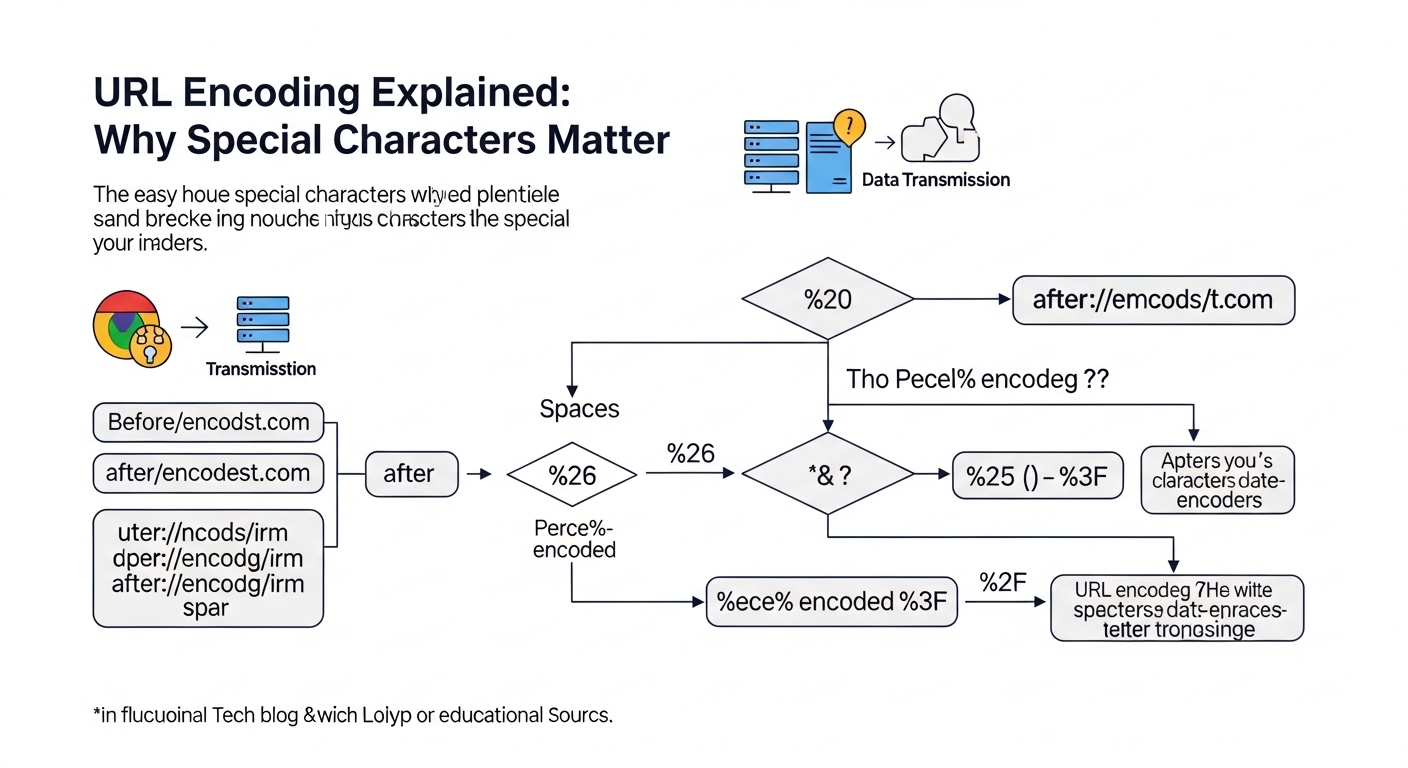
Understanding percent-encoding and how URLs handle special characters.
What Is URL Encoding?
URL encoding (also called percent-encoding) is a mechanism for encoding special characters in Uniform Resource Locators (URLs) so they can be safely transmitted over the internet. The URL specification defines a set of 'safe' characters (letters, numbers, and a few symbols like - _ . ~) that can appear in URLs without modification. All other characters must be encoded as a percent sign followed by their two-digit hexadecimal ASCII code — hence 'percent-encoding'. A space becomes %20, an ampersand becomes %26, a forward slash becomes %2F.
Why URLs Need Encoding
URLs have a specific syntax where certain characters have special meanings. The ? separates the path from query parameters. The & separates query parameters from each other. The = separates parameter names from values. The # indicates a fragment identifier. If your parameter value contains any of these characters, the URL parser will misinterpret them as syntax rather than data. Encoding converts these reserved characters into their percent-encoded form, allowing them to be transmitted as data rather than interpreted as structure.
Query Strings and Form Submissions
When you submit an HTML form with method='GET', the browser encodes the form data as a query string appended to the URL. A search for 'unit converter & calculator' becomes ?q=unit+converter+%26+calculator in the URL. Web servers decode this string before processing the parameters. This encoding/decoding cycle is invisible to most users but is fundamental to how web forms, search engines, and API calls transmit data. Developers working directly with URLs or API requests need to encode values explicitly.
Common Characters and Their Encodings
Key characters to know: space = %20 (or + in query strings), ! = %21, # = %23, $ = %24, % = %25, & = %26, + = %2B, / = %2F, : = %3A, = = %3D, ? = %3F, @ = %40. Non-ASCII characters (like accented letters, Chinese characters, Arabic script) are first converted to their UTF-8 byte sequences, then each byte is percent-encoded. A single Chinese character may encode to 9 characters (three bytes, each as %XX) in a URL.
URL Encoding vs. HTML Encoding
URL encoding and HTML encoding are different systems for different purposes. HTML encoding (also called HTML entities) escapes characters that have special meaning in HTML: < becomes <, > becomes >, & becomes &, " becomes ". URL encoding, by contrast, makes arbitrary text safe for transmission in URLs. Confusing these two encoding systems is a common source of bugs — applying HTML encoding to a URL or vice versa produces incorrect output. Our URL encoder/decoder tool handles URL-specific percent-encoding correctly.